

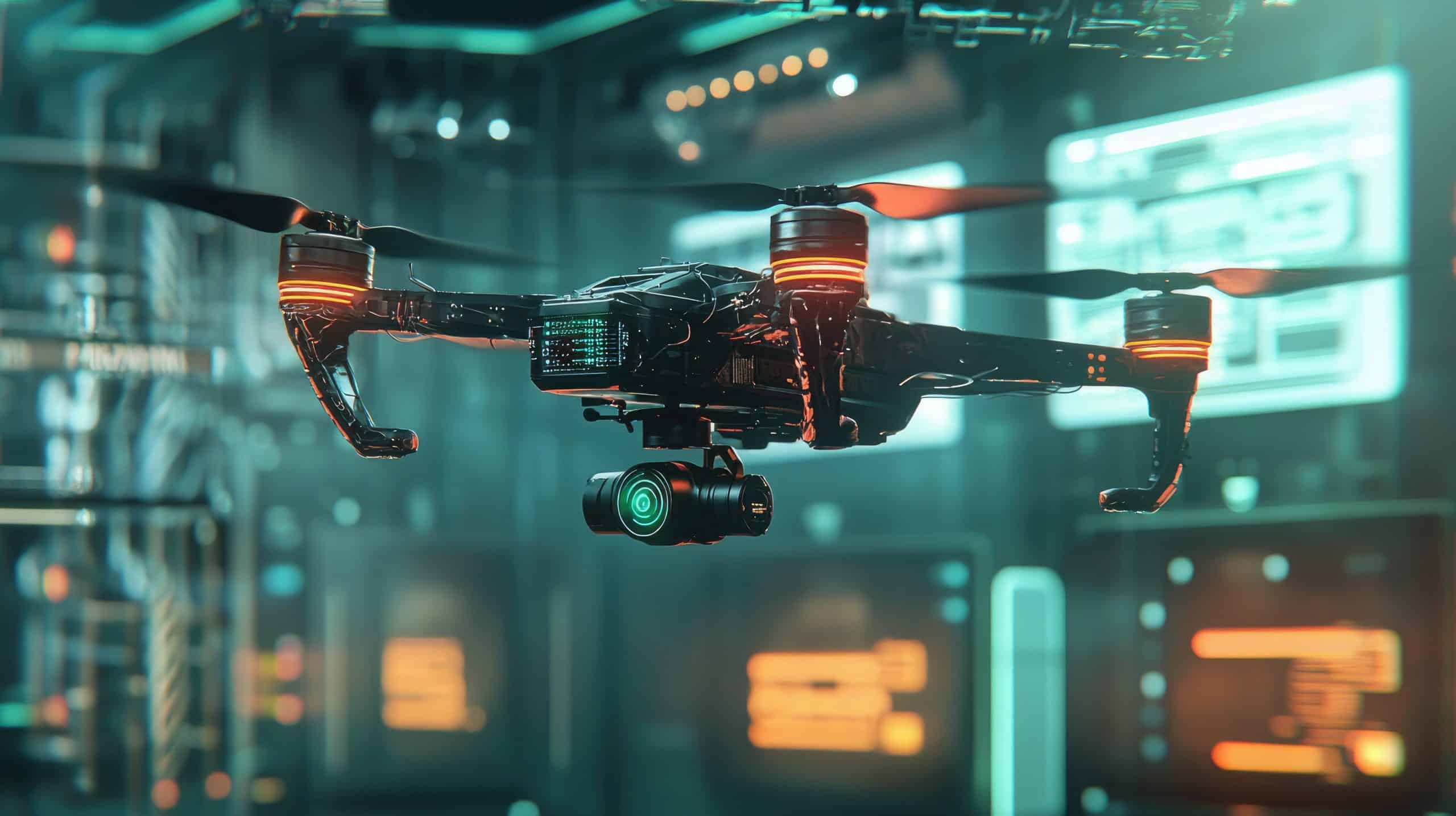
Long before a military drone ever takes off for its first mission – before it captures a single frame of ISR footage or locks onto a target – dozens of decisions have already been made. Those decisions happen in laboratories and manufacturing floors, where drone hardware component manufacturers design the sensors, processors, and power systems that determine everything a UAV can ultimately do.
By the time a drone reaches the field, its capabilities have already been set by these components: how far it will see, how long it will fly, how intelligently it will operate, and how resilient it will operate under pressure. And that’s where the real story of where military UAV innovation begins.
Market Drivers: Component Manufacturers’ Impact on Growth
The global drone payload market size is projected to grow from USD 10.72 billion in 2025 to USD 32.73 billion by 2032, mainly driven by the combat and combat support mission segments. In military programs, capability always starts at the component level: better sensors enable better ISR, better processors enable autonomy, and better power systems extend endurance. This is why hardware suppliers now stand as one of most influential market-driving forces, because they ultimately determine the performance that drives this growing demand.
Consider how much of a drone’s strategic value comes down to the components inside:
| Component | Contribution to Military UAV Value | Role of Component Manufacturers |
|---|---|---|
| ISR Sensors | Image clarity, detection range, night ops | Build compact, high-fidelity optics for tactical environments |
| Processing & AI | Autonomy, ISR analysis, sensor fusion | Deliver ruggedized edge-computing with real-time intelligence |
| Power Systems | Endurance, payload capacity | Engineer efficient, lightweight energy systems |
| Communications | Range, security, BVLOS control | Provide jam-resistant, encrypted connectivity |
Every advancement – whether a longer-endurance UAV, a more autonomous recon drone, or a platform capable of operating deeper into denied airspace – begins with new breakthroughs from drone hardware components manufacturers.
Defense customers know it, too. Increasingly, they are choosing platforms not specifically for the airframe, but for its component ecosystem. As defense organizations accelerate adoption of BVLOS (Beyond Visual Line of Sight) intelligence, precision targeting, and battlefield situational awareness, the pressure on component-level performance has never been higher.

Technological Improvement: The Urgency in Power and Intelligence Systems
Military UAVs are restricted by two fundamental technical challenges: energy and intelligence. Even the most capable UAVs are limited without efficient power systems and advanced onboard computing. Inside the industry, component manufacturers are racing to solve these bottlenecks by advancing:
- High-density smart batteries and refined power distribution
- Real-time edge-AI processors
- Resilient video-intelligence modules
- Low-latency, tactical-grade communications hardware
- Autonomous navigation components for GNSS (Global Navigation Satellite System) compromised environments
Component Innovation: Miniaturization and High-Performance Payloads
As missions become more specialized, for example, maritime ISR, border patrol, urban reconnaissance, and convoy support, drones must carry more capability in less space. This has pushed component manufacturers to redefine what miniaturized really means. New generations of hardware components now offer:
- Smaller yet more powerful EO/IR (Electro-Optical/Infrared) sensors
- Lightweight thermal and low-light modules
- Ultra-compact tactical computing boards
- High-performance, low-SWaP video processors
- Modular architectures that allow quick reconfiguration
- Multi-spectral and fusion-ready payload assemblies
Supply Chain: Manufacturers as the Core Stable Market Force
Unlike UAV airframes, which follow long procurement cycles and are often delayed by budgets or political changes, hardware components are an essential part of every UAV program. Even when the purchase of new drones slows down, militaries still need to replace worn sensors, upgrade aging processors, and add new communications modules to keep their existing fleets mission-ready.
For example, a military unit may not receive approval for a new UAV this year, but it will likely receive authorization to upgrade the cameras on its current drones for better night performance. Another unit may not get a next-generation platform, but it can still add a new AI processing module to improve target detection on flights. These smaller upgrades keep demand for components high, even when the larger programs stall.
How does this make drone hardware components manufacturers the silent backbone of the global UAV market?
They supply standardized modules across multiple UAV families. For example, the same stabilized EO/IR camera module might fit both a small quadcopter and a larger fixed-wing surveillance drone.
They enable modernization without replacing entire fleets. A simple processor upgrade can give a five-year-old drone new autonomous capabilities, delaying the need for a costly aircraft replacement.
They ensure interoperability across new and legacy drones. Common connectors, interfaces, and data links allow older drones to carry newer sensors without redesigning the entire system.
They accelerate incremental improvements that immediately impact mission readiness. Upgrading just one component, such as adding a more efficient battery pack or a stronger radio, can extend mission time or improve signal reliability right away. So while drones capture attention in the sky, it’s the component manufacturer working behind the scenes that keeps the entire UAV ecosystem stable and fly-worthy.
Future Components: Trajectory Toward Modular and Specialized Design
Looking ahead, it is clear that the most significant shifts in military UAV design will come from its hardware components. Component manufacturers are the ones empowering militaries to adapt faster, integrate intelligence more efficiently, and upgrade capabilities without redesigning entire platforms. As defense budgets shift toward unmanned platforms, manufacturers capable of providing miniaturized, ruggedized, military-grade components are increasingly positioned as primary influencers in the global military drone/UAV market trends.