


The drone was already airborne when the feed began to stutter.
From thousands of meters above a military zone, a full-motion video stream flowed toward operators waiting for confirmation. Shapes moved below. Heat signatures flickered. Something was there… but not clear enough, not fast enough.
By the time the video reached the command center, the moment had passed.
This is the reality of modern ISR missions. Sensors are better than ever. Cameras are sharper. AI models are smarter. But when intelligence depends on sending massive video streams back to centralized servers or cloud systems – latency becomes the enemy.
This is where military edge computing video changes the equation. How? By moving processing, intelligence, and decision-making closer to where the data is actually created.
The Limits of Centralized and Cloud-Based Video Processing
For years, ISR architectures followed a standard model: collect data in the field, transmit it back, analyze it centrally, then respond. That model worked when video resolutions were lower and bandwidth was abundant.
Today, none of those assumptions hold.
ISR platforms now generate multiple simultaneous video streams, often from Electro-Optical/Infrared (EO/IR) and thermal sensors. These feeds have to travel over complex, narrowband, or intermittent links. When it comes to centralized or cloud-based processing, there are three main challenges to consider:
- Latency that delays threat detection
- Bandwidth bottlenecks that degrade video quality
- Vulnerability to jamming or network disruption
Even a few seconds of delay makes all the difference.
Edge Computing Enables Real-Time Intelligence
Edge computing introduces innovation to the ISR model.
Instead of shipping raw video data back for analysis, edge computing platforms process intelligence at the source – onboard UAVs, ground vehicles, or forward-deployed command nodes.
This allows ISR systems to analyze video locally, detect threats in real time, and transmit only actionable insights instead of raw data.
Edge computing allows military operators to benefit from faster decisions, lower bandwidth usage, and greater operational autonomy. In practical terms, edge computing transforms video from something military command watches into something that actively informs.
Reducing Latency in ISR Video Streams
Traditional ISR pipelines introduce a delay at every step: transmission, buffering, decoding, processing, and redistribution. Edge computing eliminates much of this risk.
By combining low-latency video encoding, hardware-accelerated AI, and onboard processing – edge platforms deliver insights in milliseconds rather than seconds. Instead of waiting for confirmation from a distant operations center, field units can respond immediately, while the situation is still unfolding.
This is the core advantage of real-time military video processing at the edge.
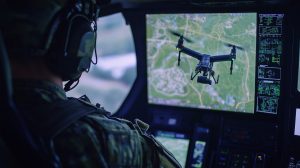
Multi-Sensor Fusion at the Tactical Edge
Single camera feeds are no longer relevant in modern ISR. Real situational awareness comes from multi-sensor fusion, combining EO/IR, thermal, radar, and metadata into a single operational picture. Edge computing platforms make this possible in real time.
Rather than streaming multiple raw feeds back to a central system, edge systems correlate inputs locally, synchronize timestamps, and apply AI models across data sources. The result is a clearer, faster, and more accurate understanding of what is happening on the ground – without overwhelming communications links.
How Edge Platforms Increase Mission Survivability
ISR systems that depend on constant backhaul connectivity are fragile. If links degrade or fail, intelligence capabilities collapse. Edge computing increases the probability of success by enabling autonomous operation.
Even when communications are limited or denied, edge platforms can continue to encode and store video locally, run AI models for detection and classification, and prioritize and transmit critical data when links are restored.
Maris-Tech’s Edge Computing Capabilities for ISR Units
Maris-Tech designs its platforms for tactical operations. Its edge computing products for real-time military video intelligence combine three critical elements:
- Low-latency video encoding (H.264/H.265, multi-stream)
- AI acceleration for onboard analytics
- SWaP-optimized designs suitable for airborne and ground deployment
These solutions are built to operate at the tactical edge, where power, space, and bandwidth are limited – but performance is still non-negotiable. Maris-Tech enables real-time intelligence where it matters most – in the field.
Integrating Edge Platforms Into UAVs and Command Systems
Edge computing must integrate seamlessly into existing ISR ecosystems. Maris-Tech systems are designed for easy integration with:
- UAV payloads
- Ground control stations
- Command-and-control systems
- Tactical networks
By using standard interfaces, adaptive streaming, and modular designs, these systems let defense integrators upgrade ISR capabilities without rebuilding their entire platforms.
A Tactical Shift for the Future
Edge computing is often discussed as an infrastructure trend. In ISR, it is something more fundamental. It represents a shift in how intelligence flows – away from centralized dependency and toward distributed, resilient, real-time awareness.
For operators in the field, this shift means clearer insights and faster action when they can trust the data guiding their decisions.
For defense organizations, it means ISR systems that can handle even the most complex mission.