

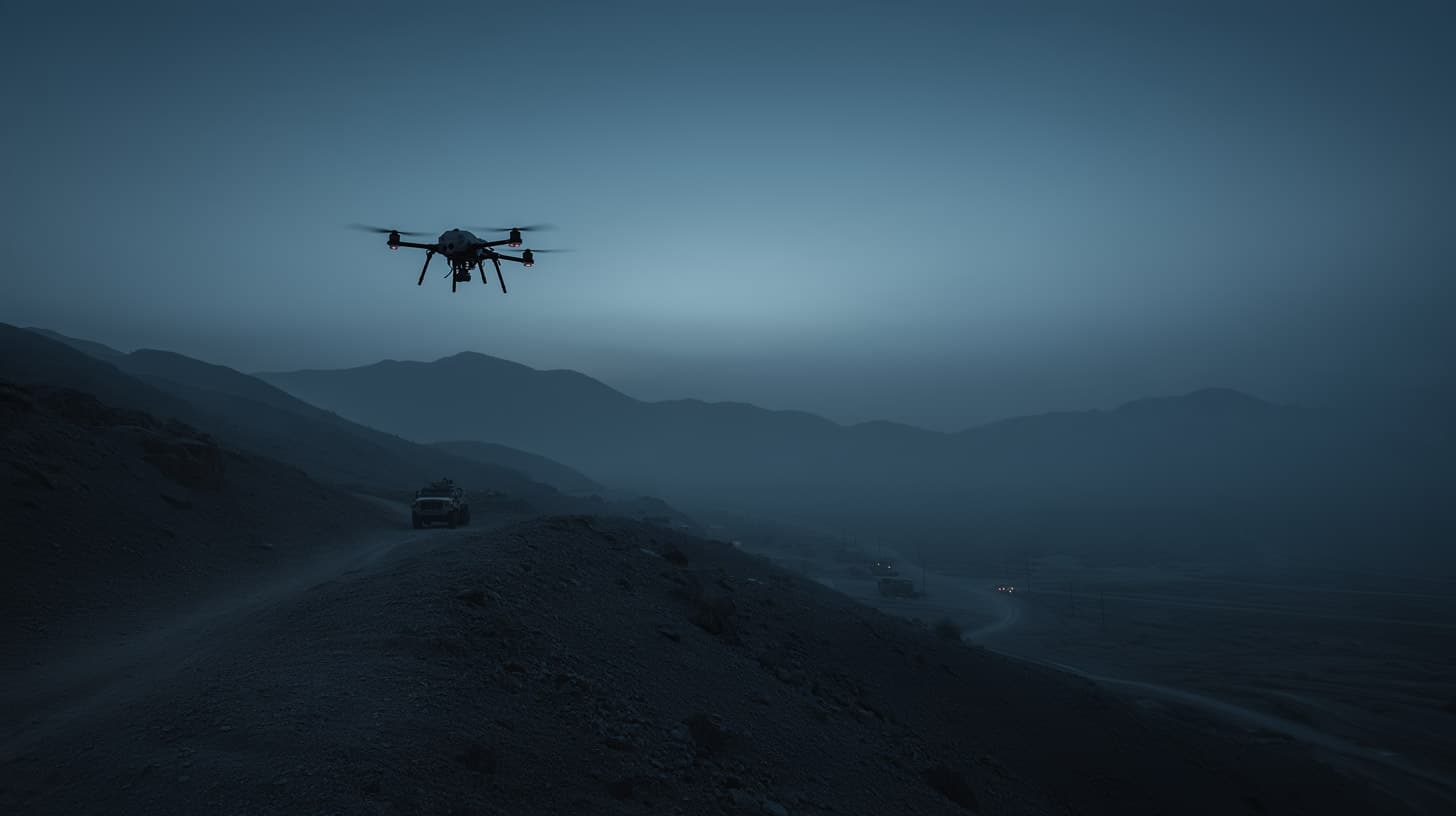
Drone situational awareness answers the question of what happens when the area you need to see is beyond the reach of your ground-based sensors? What if the target is beyond the ridge, behind the building, or farther down the route than a vehicle-mounted sensor can see?
Ground-based cameras, vehicle-mounted sensors, and personnel can provide detailed awareness of the area around them, but terrain, buildings, vegetation, distance, and other obstacles can limit what they can see. Even advanced situational awareness systems remain limited by the physical position of their sensors.
Drones can help close this gap by moving the observation point above or around obstacles. But simply setting up a camera in the air is not enough. For airborne coverage to support real-time decisions, video has to reach operators quickly and reliably, and detection needs to happen fast enough for the information to still be relevant.
Why Line-of-Sight Awareness Has Limits
Every ground-based observation system has a physical boundary beyond which nothing can be viewed. A vehicle operating in an urban environment can lose visibility around buildings. A perimeter security system can have areas obscured by structures or terrain. Ground units moving through uneven terrain may be unable to see what is happening beyond a ridge or other obstruction.
Adding more ground-based cameras can improve coverage, but it does not eliminate every blind spot. Their location still determines what they can see. This is where a situational awareness UAV can add another layer of visibility. Instead of replacing existing ground-based systems, the airborne platform literally extends their reach.
How Drone Situational Awareness Closes the Visibility Gap
An airborne camera on a drone can move above terrain, reposition as conditions change, and provide video from areas outside the direct visual range of personnel or vehicle-mounted sensors. The U.S. Army has similarly described small UAS as a way to screen areas that ground reconnaissance teams cannot see, extending observation and providing earlier warning. This makes UAS situational awareness useful where operators need a broader picture than fixed or ground-level sensors can provide.
Maris-Tech’s Uranus Drones is an example of the technology required to support this type of airborne coverage. The compact onboard module provides ultra-low-latency video streaming and onboard processing for drone applications.
The important distinction is that the drone does not replace ground-based situational awareness. It just adds another observation point to the system.
| Awareness Challenge | Ground Based Approach | Drone Extended Approach | Maris-Tech Example |
| Coverage past line of sight | Limited to visible terrain and mounted sensor range | Airborne view extends past obstacles and the horizon | Uranus Drones (compact, ultra-low-latency onboard module) |
| Real time threat detection | Onboard AI classification on the vehicle | Same detection logic applied to an airborne feed | Diamond Ultra (real time AI threat classification for AFVs; vehicle-mounted, not airborne) |
| Day and night coverage | Fused day and thermal imaging, ground mounted | Same imaging approach adapted to smaller, lighter platforms | Peridot Night (day plus thermal, modular 90 degree to 360 degree coverage; vehicle-mounted, not airborne) |
| Continuous monitoring | 360 degree OEM situational awareness module | Persistent airborne coverage over a wider area | Uranus Ultra (real time monitoring and threat detection; OEM ground module, not airborne) |
What Makes Drone Situational Awareness Real Time?
A drone may be able to see beyond a ground unit’s visual range, but that advantage is reduced if its video arrives too late. This explains why low latency video streaming is a critical part of drone situational awareness. Operators need to receive information quickly enough to understand what is happening and respond while the information is still relevant.
Onboard processing can further reduce the time between capture and detection. Instead of sending every frame to another system for analysis, AI processing can take place close to the source.
Maris-Tech uses this approach across its situational awareness technology. Diamond Ultra, for example, provides real-time AI-based threat classification for armored fighting vehicles. Uranus Ultra supports real-time monitoring and threat detection in an OEM ground module.
These products do not operate on drones. Rather, they demonstrate the same underlying approach — real-time video processing and detection — that can be applied to airborne platforms. Uranus Drones brings this capability directly onboard the drone, combining video processing with ultra-low-latency streaming.
Where Drone-Based Situational Awareness Is Used
The ability to extend visibility beyond ground-level obstacles can support several defense and homeland security applications.
In perimeter security, an airborne platform can provide an elevated view of areas that fixed cameras may not cover. It can also reposition as the area of interest changes.
For convoy protection, a drone can provide visibility beyond the immediate viewing range of the vehicles, helping extend observation farther along a route or around obstacles.
Drones can also complement vehicle-mounted and ground-based sensors by adding a mobile observation point to help with overall battlefield awareness. Information from the airborne platform can then contribute to the wider visual picture available to operators.
What to Look for in a Drone-Based Situational Awareness Setup
Camera resolution is only one consideration when evaluating an airborne situational awareness system. Here are a few others:
- Latency determines how quickly operators receive the video. A high-quality image has limited operational value if it arrives too late to support a decision.
- Onboard processing determines how quickly information can be analyzed. Performing detection closer to the point of capture can reduce dependence on sending raw video elsewhere before analysis begins.
- Detection capability is also important where the system is expected to identify or classify objects rather than simply transmit video.
- Size, weight, power, and ruggedization matter because airborne platforms place significant constraints on onboard electronics. A processing module needs to provide the required performance without adding unnecessary burden to the platform.
Bottom Line: Extending Awareness, Not Replacing It
Drone situational awareness extends the reach of ground-based systems by providing visibility beyond obstacles and line-of-sight limits. With low-latency video and onboard processing, that additional view can become actionable information in real time.
Reach out to explore Maris-Tech’s Situational Awareness and Drones solutions, or see the technology live at AUSA 2026, Booth 761, at the Walter E. Washington Convention Center in Washington, D.C., October 12–14.
Frequently Asked Questions
- What is drone situational awareness?
Drone situational awareness is the use of an airborne platform to extend visibility and threat detection beyond what ground based sensors or personnel can see directly, closing gaps created by terrain, distance, or structures. Maris-Tech’s onboard modules, built around the same real time AI detection used in its ground vehicle situational awareness line, support this kind of airborne coverage.
- How do drones improve situational awareness beyond visual range?
By carrying a camera and processing module above the terrain, a drone can see past obstacles and over distances that ground based sensors simply cannot reach, then relay that view back in real time. The value only holds if the feed is fast enough to act on, which is why low latency streaming, such as the sub 100 millisecond performance in Uranus Drones, matters as much as the camera itself.
- What technology makes real time drone situational awareness possible?
Real time drone situational awareness depends on low latency video transmission paired with onboard AI processing, so that detection and classification happen at the point of capture rather than after a delay on the ground. This is the same architecture behind Maris-Tech’s ground vehicle systems like Diamond Ultra, applied to an airborne platform.
- How is this different from ground based situational awareness systems?
Ground based systems, such as a vehicle mounted platform, are limited to what their sensors can physically see from a fixed or slow moving position, while a drone can reposition and see over or around obstacles that would otherwise block the view. The two are complementary rather than competing, since the same real time detection approach underlies both.
- Can drone based situational awareness work at night?
Yes, when the onboard payload includes thermal imaging alongside a standard day camera, which is the same approach Maris-Tech uses in its Peridot Night module for ground vehicle coverage and applies equally well to an airborne platform. Day and night coverage matters because most contested environments don’t stop being relevant after dark.
- What latency is acceptable for a drone situational awareness feed to be useful?
Anything approaching real time, generally under a few hundred milliseconds, is what separates an actionable situational awareness feed from a delayed video stream that arrives too late to inform a decision. Uranus Drones’ 100 millisecond streaming performance illustrates the kind of latency this use case requires.
- How does drone based coverage support perimeter security or convoy protection?
A drone can maintain a moving or elevated vantage point over a perimeter or a convoy route that ground sensors alone cannot cover continuously, feeding the same kind of real time detection data that a fixed situational awareness system would provide from the ground. This extends coverage without replacing the ground based system already in place.
- What should a procurement team evaluate in a drone situational awareness setup?
Beyond camera resolution, the key factors are streaming latency, onboard detection accuracy, and how well the module withstands field conditions, since a system that looks good in a demo but degrades under real network or environmental stress won’t hold up operationally. Maris-Tech’s product range, from Diamond Ultra’s IP67 rated ruggedization to Uranus Drones’ onboard AI acceleration, reflects how these factors are addressed in fielded systems.