

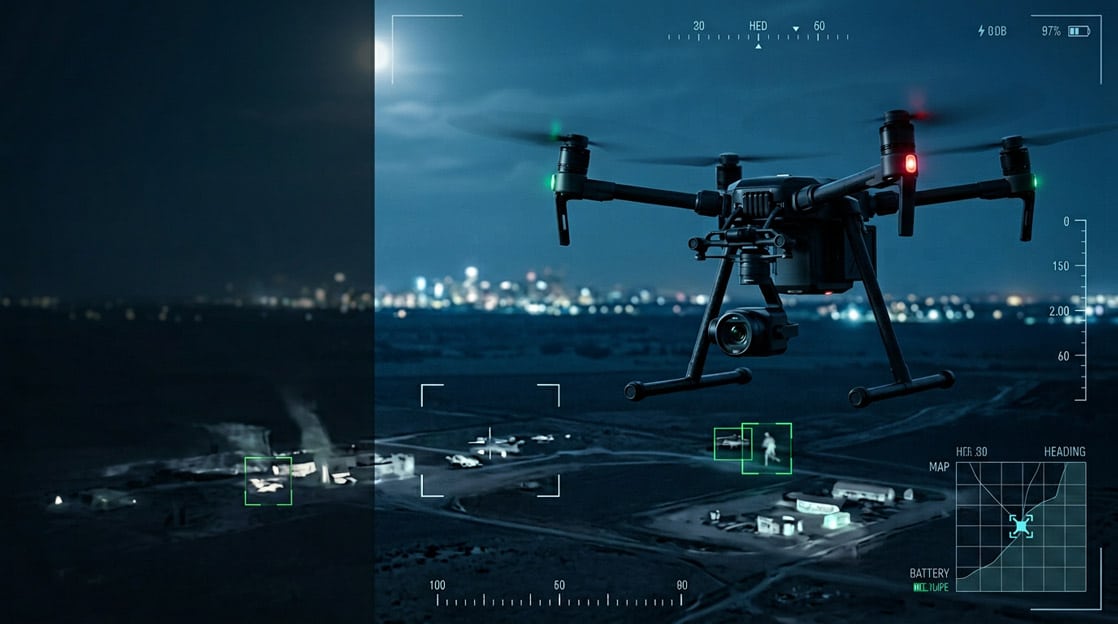
Night vision for drones has become an important capability for the military as the real test for UAVs is in the moments when visibility disappears.
What happens when there is no artificial light at all? Or no clear horizon? Only fragments of movement… shadows shifting between structures, heat lingering on the ground, signals that may or may not indicate activity. Is it, or isn’t it? This is the operational reality of nighttime ISR.
Missions cannot wait due to darkness. Intelligence must continue to flow, targets must be tracked, and battlefields must be analyzed in real time. This is where drone night vision technology and low light UAV video systems turn unmanned platforms into true intelligence assets.
Why Night Operations Are Critical in Drone Warfare
Darkness is often an advantage for military operations. Forces prefer to operate in low-visibility conditions because it allows them to move with less exposure, observe without detection, and create asymmetry against adversaries. Night operations are often the time for reconnaissance before any direct engagement begins.
For ISR teams, the challenge is maintaining clarity at night. Without reliable imaging, a drone becomes little more than a blind sensor in motion. But with advanced night vision for drones, it becomes a continuous source of situational awareness.
Low-Light UAV Video for Nighttime Intelligence
The ability to see in near-total darkness begins with low light UAV video technology. Instead of relying on artificial illumination, these systems extract images from minimal ambient light, such as moonlight reflecting off terrain or distant urban light. The goal is to capture usable intelligence even in difficult visual conditions.
Night Vision for Drones: How Low-Light Sensors Work
At the hardware level, night vision for drones is based on sensors. UAV imaging systems use high-sensitivity CMOS (complementary metal oxide semiconductor) sensors with larger pixel sizes to capture as much available light as possible. This data is then refined through onboard processing, which reduces noise and stabilizes the image.
This video stream allows operators to interpret scenes, detect anomalies, and maintain awareness in conditions that would otherwise miss the operational picture entirely.
Thermal Drone Payloads for Target Detection
Even the most advanced low-light systems are limited. When illumination drops to zero, or when visual cues are missing, another sensing layer becomes essential.
This is where thermal drone payloads take over.
Instead of relying on reflected light, thermal imaging detects differences in heat. A recently active vehicle, a person moving through terrain, or still-warm equipment — all become visible through their thermal signature.
In practice, this means that thermal systems further extend the operational capabilities of UAVs. For example:
- A stationary object that blends into its surroundings visually may stand out clearly in thermal imaging
- A target hidden in the dark may still be detected based on heat
- Movement becomes easier to track even when visibility is compromised
Combining Thermal Imaging with Drone Night Vision Technology
The most effective ISR platforms do not rely on a single perspective. By combining drone night vision technology with thermal drone payloads, UAV systems can have a multi-layered understanding of the environment. One sensor provides structure and context. The other reveals hidden activity. Together, the sensor fusion improves situational awareness in night combat and increases confidence in decision-making — particularly in fast-moving or uncertain environments.
The Future of Night Vision Drone Systems
Night vision capabilities are evolving beyond visibility alone. The next phase of development is focused on interpretation at the edge — where video is not only captured, but analyzed in real time.
Maris-Tech’s edge computing solutions enable AI-driven detection, tracking, and real-time video streaming directly at the edge. For example, Peridot Night is a standalone night-vision module with integrated AI that fuses three thermal cameras with a full-HD day camera to generate a 90° panoramic video stream. This AI-driven processing at the edge enables drones to identify patterns, flag anomalies, and prioritize relevant data before it is even transmitted.
At the same time, sensor fusion is becoming more tightly integrated. Low-light imaging, thermal data, and additional sensing modalities are increasingly combined into unified systems that deliver a more complete operational picture.
The direction is clear: drones are becoming not just platforms for observation, but systems for real-time intelligence gathering and generation, regardless of lighting conditions.
Key Capabilities of Night Vision Drone Systems
| Capability | Function | Operational Impact |
| Low light UAV video | Captures imagery in minimal illumination | Enables ISR in near-dark environments |
| Thermal drone payload | Detects heat signatures | Identifies concealed or camouflaged targets |
| Sensor fusion | Combines visual and thermal data | Improves detection accuracy and confidence |
| Edge processing | Analyzes data onboard | Reduces latency and bandwidth dependency |
Frequently Asked Questions
- What is a night vision drone?
A night vision drone is a UAV equipped with imaging systems that allow it to operate effectively in low-light or nighttime conditions. - How does night vision for drones work?
It uses high-sensitivity sensors to amplify available light or thermal sensors to detect heat signatures. - What sensors enable drones to see in the dark?
Low-light CMOS sensors and thermal infrared sensors are the primary technologies used. - What is low light UAV video technology?
It refers to imaging systems designed to capture clear, usable video in minimal illumination environments. - How do thermal drone payloads work?
They detect temperature differences, allowing identification of people, vehicles, and equipment regardless of lighting. - Why are night vision drones important in modern warfare?
They enable continuous ISR operations and provide critical intelligence gathering during nighttime missions. - How do drones conduct surveillance during nighttime missions?
By combining low-light video and thermal imaging, drones maintain visibility and tracking in real time. - What advantages do thermal sensors provide for night operations?
They allow detection in complete darkness and through visual obstructions like smoke or foliage.