

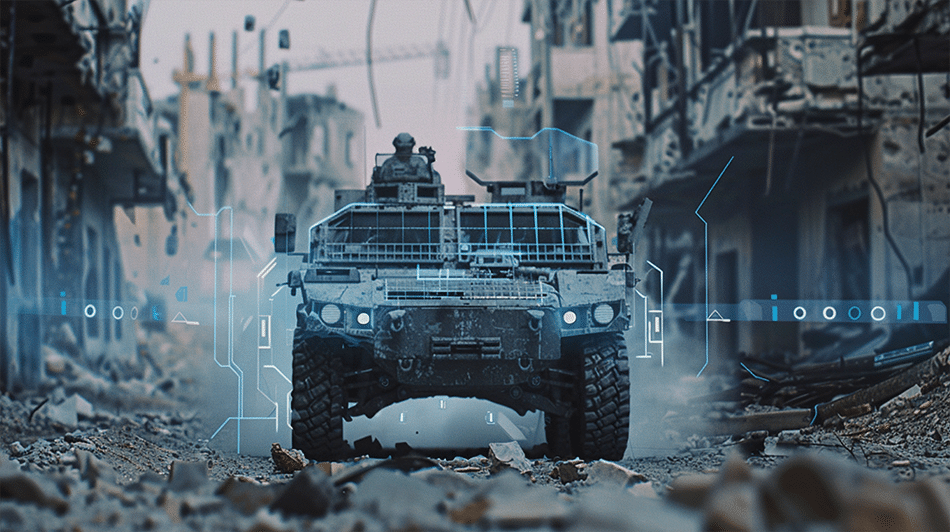
Sensor fusion situational awareness is now a critical capability in modern ISR missions:
A drone is scanning an urban environment at dusk.
Its EO camera captures movement between buildings, but shadows distort the image.
Infrared picks up a heat signature, but can’t distinguish between a vehicle and debris.
Radar detects motion, but lacks visual context.
Individually, each sensor sees part of the picture.
Together, they reveal the truth.
This is where sensor fusion for situational awareness becomes critical. By combining EO, IR, and radar data into a unified operational view, modern ISR systems can detect, track, and classify targets with far greater accuracy across any environment, in real time.
Understanding EO, IR, and Radar Sensors
To understand multi-sensor fusion defense systems, it’s critical to first examine the role of each sensor type.
EO (Electro-Optical) Sensors
EO sensors capture high-resolution visual imagery, similar to standard cameras. They provide detailed spatial information, and enable the identification of objects, terrain, and movement patterns. However, EO performance is dependent on lighting and visibility conditions.
IR (Infrared) Sensors
Infrared sensors detect thermal signatures emitted by objects. This allows systems to identify targets in the dark, smoke, or in other challenging environmental conditions. IR is especially effective for detecting human activity, vehicles, and other heat-generating systems.
Radar Sensors
Radar systems use radio waves to detect object distance, velocity, and movement. Unlike EO and IR, radar operates effectively in fog, rain, dust, and other obscured environments. Radar provides reliable tracking data, even when visual confirmation is limited.
Why Sensor Fusion Improves Situational Awareness
Taken on its own, each sensor can only provide partial insight. But together, the sensors create a comprehensive operational picture that brings clarity to decision makers.
Sensor fusion enhances overall situational awareness by eliminating blind spots and increasing detection accuracy. It reduces the chance of false positives and allows for continuous tracking across a wide range of conditions. For example, radar may detect movement, IR confirms a heat signature, and EO provides visual classification. This fusion significantly improves confidence in target identification.
AI-Powered Sensor Fusion in ISR Systems
The complexity involved with combining multiple sensor streams requires advanced processing. This is where AI comes in.
AI-driven ISR sensor fusion systems use machine learning models to correlate data from EO, IR, and radar inputs to identify patterns and classify objects based on combined signatures. This allows threats to be prioritized in real time.
Rather than processing each sensor independently, AI enables cross-referencing between data sources. This allows the system to “understand” the environment… not just observe it. For example, AI can associate radar motion data with an IR heat signature and EO visual confirmation to classify a moving object as a vehicle rather than a false alarm.
Combining EO, IR and Radar Data with Edge AI
Even better is when processing occurs at the edge — not remotely in a centralized system. Edge AI platforms integrate multiple sensors directly onboard UAVs, vehicles, or fixed installations. This enables:
- Real-time data fusion
- Reduced latency
- Lower bandwidth requirements
- Autonomous decision support
By processing EO IR radar AI data locally, systems can deliver immediate insights without relying on remote infrastructure. This is especially critical for UAVs and autonomous systems operating in dangerous or disconnected environments.
Multi-Sensor Tracking and Target Detection
One of the most significant advantages of EO IR sensor fusion is improved tracking continuity.
| Capability | EO Sensor | IR Sensor | Radar Sensor | Sensor Fusion Outcome |
| Daylight Detection | High | Medium | High | Enhanced classification |
| Night Detection | Low | High | High | Continuous visibility |
| Obscured Conditions | Low | Medium | High | Reliable tracking |
| Target Classification | High | Medium | Low | Accurate identification |
| Motion Tracking | Medium | Medium | High | Persistent tracking |
With sensor fusion, systems can maintain lock on targets even if one sensor temporarily loses visibility.
Operational Applications of Sensor Fusion in UAV and ISR Missions
UAV Surveillance: UAVs equipped with EO, IR, and radar sensors can monitor large areas while maintaining continuous target tracking.
Autonomous Defense Systems: Sensor fusion allows autonomous platforms to detect and respond to threats without constant human intervention.
Perimeter Defense: Multi-sensor systems provide layered security, identifying intrusions with higher accuracy and fewer false alarms.
Battlefield Awareness: Armored vehicles and ground systems use sensor fusion to maintain 360° situational awareness, even in complex urban environments.
Challenges in Multi-Sensor Data Integration
While the benefits are clear, integrating multiple sensors presents several technical challenges, including:
Data Synchronization: Different sensors operate at varying frame rates and resolutions. These data streams must be aligned for accurate fusion.
Bandwidth and Processing Load: Combining EO, IR, and radar data generates significant computational demand, which requires optimized edge processing architectures.
Calibration and Alignment: Sensors must be precisely calibrated to ensure spatial and temporal alignment. Any misalignment can degrade the system’s accuracy.
Environmental Variability: Changing weather, terrain, and operational conditions can affect sensor performance differently, requiring adaptive fusion algorithms.
Maris-Tech Approach to Real-Time Sensor Fusion at the Edge
Addressing these challenges requires robust system design and advanced AI models.
Maris-Tech’s platforms are engineered to ingest and process EO, IR, and radar streams simultaneously, using AI-driven analytics at the edge to reduce latency and ensure reliable performance under operational constraints.
By combining ruggedized hardware with optimized video and AI processing pipelines, Maris enables defense systems to move from fragmented sensor inputs to a unified, actionable situational awareness layer—delivered in real time, where it matters most.
Future of AI Sensor Fusion in Defense Systems
This edge-first approach reflects where multi-sensor fusion in defense is heading… toward deeper AI integration and greater autonomy. Advances in AI models, more efficient edge hardware, autonomous decision-making, and the addition of sensors like LiDAR and RF are all driving this shift.
As defense environments become more complex, the ability to fuse and interpret multiple data sources is critical. Sensor fusion has become a core requirement for modern ISR systems.