


Situational awareness in the military and defense sector is the cornerstone of effective operations, enabling forces to make informed decisions in rapidly changing environments. This capability has never been more critical, as contemporary challenges demand an unprecedented level of strategic insight and operational flexibility. Maris-Tech delves into the situational awareness market, technological advancements, and future prospects of situational awareness systems within this vital sector. In 2026, situational awareness extends beyond traditional domains into increasingly integrated multi-domain operations, where air, land, sea, space, and cyber domains are monitored and coordinated with improving levels of timeliness and cross-domain awareness.
What is Situational Awareness in the Military?
The essence of military situational awareness lies in the ability to perceive, comprehend, and anticipate developments in the operational environment accurately. It serves as the bedrock for decision-making processes, affecting everything from strategic planning to tactical execution. Militaries are increasingly emphasizing proactive projection — not just observing the current picture, but using AI/ML and predictive analytics to anticipate future states of the battlespace. This trio of detection, comprehension, and projection is vital in high-pace ISR environments. Commanders leverage common operational pictures (COPs) enriched by fused data from UAVs, sensors, and satellite feeds in real time.
This is hugely significant in the defense domain, and some of the military situational awareness benefits include:
- Improved operational efficiency
- Reduced risks
- Better outcomes
As modern threats evolve, situational awareness military systems must now support multi-domain operations, cyber resilience, and rapid information sharing across joint forces.
Why is Situational Awareness Important for Military Security and Intelligence?
Situational awareness is critical to military security and intelligence because it directly impacts how effectively forces detect threats, protect assets, and execute missions in dynamic environments.
For intelligence operations, situational awareness enables continuous monitoring of enemy behavior, terrain conditions, and force movements. Advanced ISR systems combine sensor feeds, video analytics, and intelligence data to form a COP that supports faster and more accurate decision-making. This capability is especially important in contested environments, where commanders must act with confidence despite uncertainty and rapidly evolving threats.
Applications of Situational Awareness in Military Scenarios
Situational awareness technologies can be used in a wide range of military scenarios, from tactical engagements to strategic security missions. Some examples of common applications:
In battlefield operations, situational awareness systems provide real-time monitoring of troop positions, vehicle movements, and environmental conditions. Integrated sensor platforms and video analytics help commanders track friendly and hostile forces, reducing the risk of miscommunication and improving coordination during complex maneuvers.
For reconnaissance missions, UAVs and ground-based ISR systems provide continuous surveillance and automated threat detection. Edge AI analytics allow rapid identification of objects, behaviors, and anomalies, which allows forces to respond quickly without relying solely on centralized processing.
Force protection and perimeter security also benefit from situational awareness. Military bases, vehicles, and critical infrastructure use multi-sensor monitoring to detect intrusions, airborne threats, and suspicious activity. These systems support early warning and rapid response protocols that enhance personnel safety.
Situational Awareness Market Insights: A Glimpse into the Present and Future
The market for situational awareness systems is on an upward trajectory, fueled by the increasing complexity of military engagements and the growing need for advanced surveillance, reconnaissance, and combat operations. Mordor Intelligence reports that the Situational Awareness Market size was valued at $28.33 billion in 2025 and estimated to grow from $30.31 billion in 2026 to $42.49 billion by 2031, at a CAGR of 6.99%
Key trends shaping the situational awareness systems market include the integration of machine learning (ML) and artificial intelligence (AI), the adoption of advanced sensor technologies, and the development of networked communication systems for seamless information sharing. In recent developments, the adoption of cloud computing and big data analytics has further enhanced the operational capabilities of situational awareness systems, enabling more efficient data management and analysis. These advancements are enhancing the ability of military and defense forces to operate more effectively in diverse and challenging environments. In 2026, the situational awareness market continues to expand as militaries invest in AI-enabled analytics, edge computing architectures, and networked command systems capable of processing vast volumes of real-time battlefield data.
Key players in the situational awareness market are General Electric (US), Lockheed Martin (US), Honeywell (US), DENSO (Japan), BAE Systems (UK), UTC (US), Microsoft (US), Barco (Belgium), AMD (US), L3Harris Technologies (US), General Dynamics (US), Xilinx (US), Qualcomm (US), Robert Bosch (Germany), Pleora Technologies (Canada), Nexvision (France), Bertin Instruments (France), Axis Communications (Sweden), Johnson Controls (Ireland), Boeing (US), Airbus (France, and Sensara (US).
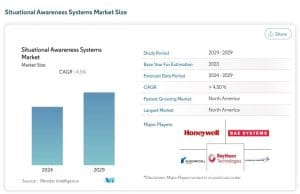
Source: https://www.mordorintelligence.com/industry-reports/situational-awareness-systems-market
Challenges and Opportunities for Situational Awareness Military Systems
While the potential of situational awareness systems is immense, the path forward is not without challenges. The integration of new technologies with existing platforms, cybersecurity concerns, and the need for interoperability among allied forces are significant hurdles to overcome. However, these challenges also present opportunities for innovation and collaboration among industry players, governmental agencies, and research institutions in advancing homeland security situational awareness as well as situational awareness in the military. In addition, the increasing focus on space situational awareness has emerged as a new frontier, necessitating advanced monitoring and analytical capabilities to ensure space asset safety and security.
Situational Awareness Technology and its Future
Looking ahead, the future of situational awareness in the military and defense sectors is poised for transformative changes, driven by rapid technological advancements. Emerging situational awareness military technology is set to revolutionize how armed forces interact with their environment, making operations more effective and responsive. Some examples:
Situational Awareness and Autonomous Vehicles
The deployment of unmanned aerial vehicles (UAVs) and autonomous underwater vehicles (AUVs) in surveillance missions is a prime example of this shift. UAVs have been extensively used for intelligence, surveillance, and reconnaissance (ISR) missions, providing real-time data and imagery without risking human lives. AUVs offer similar advantages in naval operations, capable of conducting underwater surveys and mine detection autonomously, enhancing naval situational awareness without direct human oversight.
AI & Edge Computing in Situational Awareness
A pivotal advancement in situational awareness is the integration of Edge AI computing with real-time sensor analytics. Edge AI platforms integrated into UAVs, ground vehicles, and soldier systems allow automated detection, classification, and prioritization of threats without requiring constant connection to remote data centers.
These systems are increasingly incorporated into modern ISR architectures, particularly in new platforms and mission-specific deployments. In 2026, militaries have increasingly adopted AI edge computing for onboard object recognition, and are now reducing network load and improving decision speed.
Multi-Domain ISR & Networked Awareness
Situational awareness technologies are increasingly designed to support multi-domain ISR operations. For example, NATO’s Joint ISR initiatives illustrate how integrated sensor networks and interoperable command structures enhance awareness across ground, air, maritime, space, and cyber fields. This networked model ensures that distributed forces share the same real-time operational picture.
Predictive Analytics for Threat Assessment
The use of ML algorithms to analyze vast amounts of data from various sources can predict potential threats before they materialize. An example is the U.S. Department of Defense’s Project Maven, which uses AI situational awareness systems that can sift through extensive drone and satellite imagery to identify threats, enabling proactive measures in conflict zones and improving the timeliness and accuracy of military responses.
Integration of 5G Technology
The rollout of 5G networks has dramatically improved communication speed and reliability for military operations. With its high data rate and reduced latency, 5G enables a new level of real-time information sharing and coordination. For example, it can facilitate the instant transmission of high-definition video feeds from UAVs to command centers, ensuring that decision-makers have access to the most current operational picture. In addition, 5G’s capacity for supporting a massive number of connected devices simultaneously is critical for the Internet of Battlefield Things (IoBT), where sensors, wearables, and other IoT devices on the battlefield are interconnected, providing comprehensive situational awareness.
Situational Awareness in the Military: Concluding Thoughts
As situational awareness in the military continues to evolve, the military and defense sectors stand at the precipice of a new era of operational capability and strategic foresight. The ongoing developments in situational awareness technology and the shifting dynamics of global security necessitate a continued focus on enhancing situational awareness capabilities. Embracing these changes and overcoming associated challenges will be crucial for maintaining a competitive edge and ensuring the safety and effectiveness of military defense operations in the years to come. For more information on current situational awareness technologies in the video streaming sector, contact Maris-Tech.
Situational Awareness Military Technology FAQs
What is situational awareness in the military?
Situational awareness in the military refers to the ability to understand current conditions, threats, terrain, and friendly force positions in order to make informed operational decisions.
What is situational awareness technology?
Situational awareness technology includes sensors, software, communications networks, and analytics tools that collect, process, and display real-time operational data.
Why is situational awareness important in modern warfare?
It enables faster decision-making, reduces uncertainty, improves coordination, and increases survivability in complex and rapidly changing combat environments.
What is a tactical situational awareness system?
A tactical situational awareness system provides real-time visibility at the unit or battlefield level, integrating data from drones, vehicles, sensors, and command systems.
How does AI improve situational awareness?
AI automates data analysis, identifies patterns, detects threats, and prioritizes alerts, allowing operators to focus on decision-making rather than data interpretation.
What role do drones play in situational awareness?
Drones provide real-time aerial intelligence, surveillance, and reconnaissance, significantly expanding visibility beyond ground-based sensors.
How does edge computing support situational awareness?
Edge computing processes data directly at the source, reducing latency and enabling real-time situational awareness even with limited connectivity.
What challenges affect military situational awareness systems?
Common challenges include data overload, cybersecurity risks, interoperability issues, bandwidth limitations, and operating in GPS- or communication-denied environments.
How is situational awareness evolving in 2026?
In 2026, situational awareness systems emphasize AI-driven analytics, sensor fusion, autonomy, resilient communications, and multi-domain integration.
What is real-time battlefield intelligence?
Real-time battlefield intelligence refers to continuously updated operational data that allows commanders to monitor threats, movements, and conditions as events unfold.