

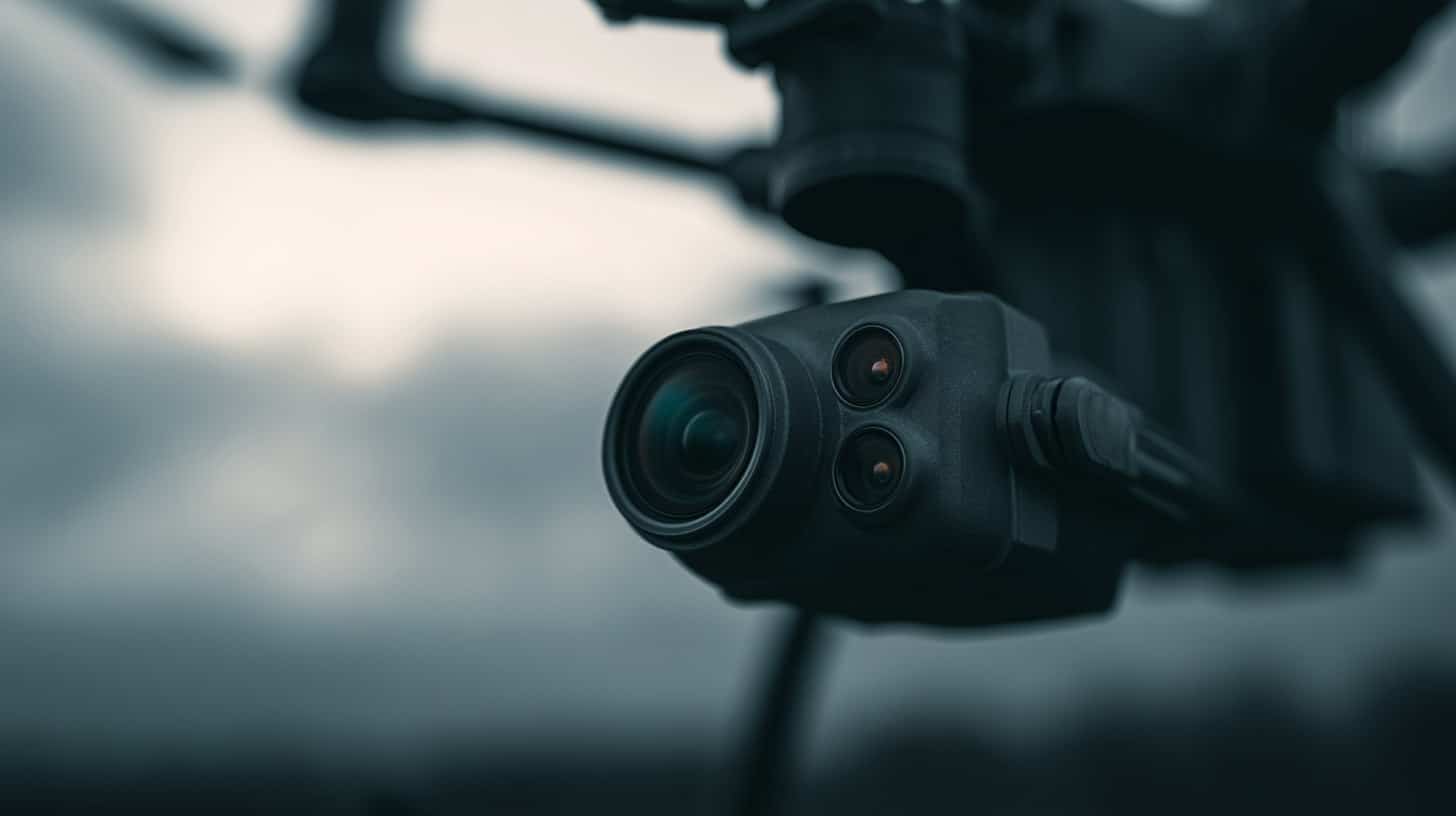
What Are Drone Payloads?
Understanding the different types of drone payloads used in ISR missions has become increasingly important — both for UAV manufacturers and defense organizations, and for system integrators responsible for building next-generation intelligence platforms.
A drone flying over contested terrain at night may only have seconds to identify a threat, transmit intelligence, and support a tactical decision. In IISR operations, that capability depends almost entirely on the payload system onboard.
A drone payload refers to any sensor, device, or system mounted on a UAV to collect data, analyze or support mission objectives. In defense and surveillance environments, the true value of a drone is not about how far it can fly or how long it can stay airborne. What matters is how effectively the system can collect intelligence, process information, and deliver actionable insights in real time.
The need for ISR and surveillance operations is driving significant investments in payload technologies. Research firms estimate the global drone payload market will reach nearly $6.7 billion by 2030.
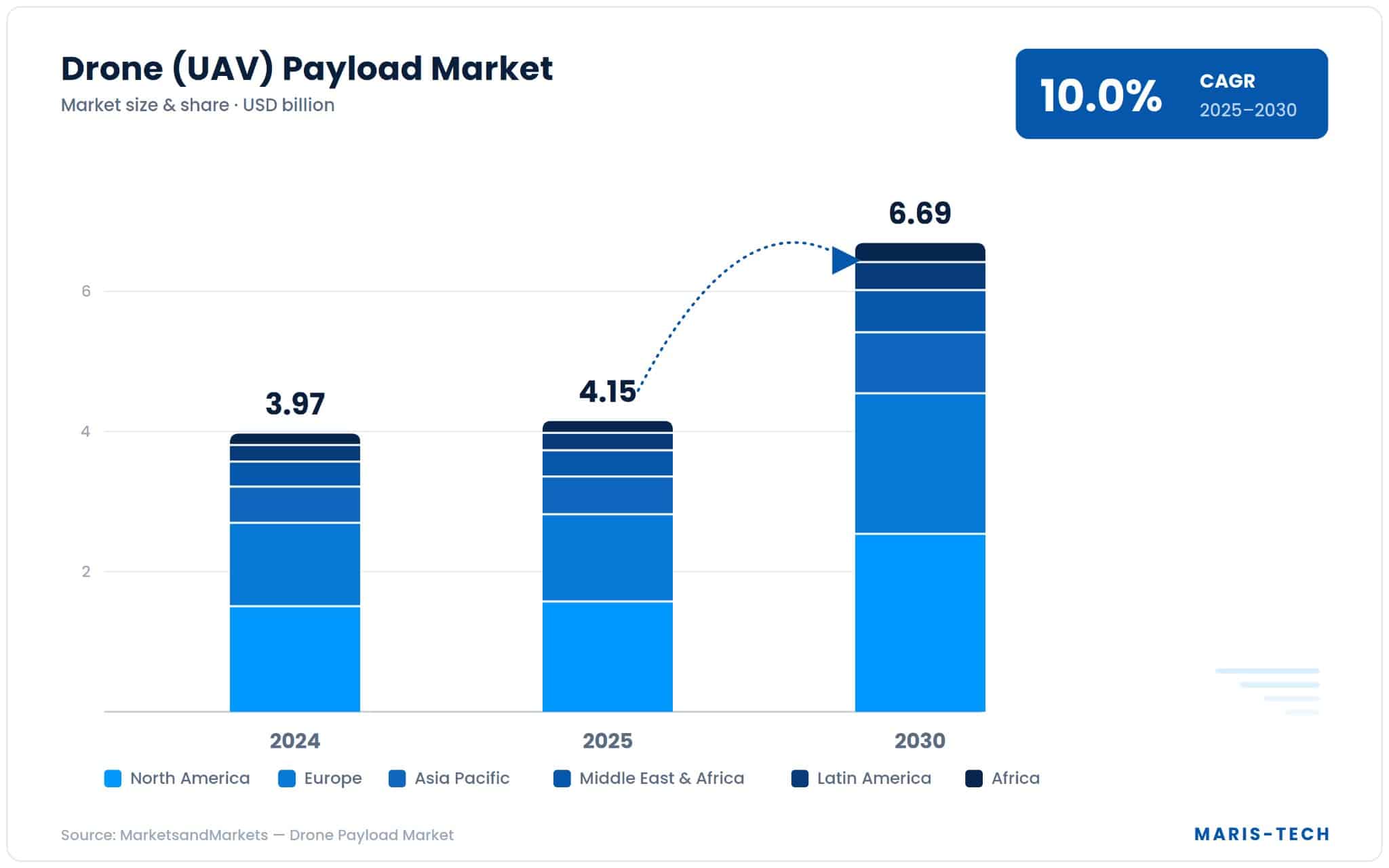
Source: https://www.marketsandmarkets.com/Market-Reports/drone-payload-market-75052126.html
One driver of this growth is video intelligence. Electro-optical sensors, thermal imaging systems, and AI-enabled video processing payloads have each become central to ISR operations. These systems allow UAVs to capture images, but also to generate actionable intelligence directly at the tactical edge.
Why UAV Payload Systems Matter for ISR, Surveillance, and Real-Time Intelligence
Think of the drone itself as the delivery mechanism. The payload is what determines what the system can see, analyze, and do. Without the right payload integration, even a sophisticated drone platform could have limited operational value.
In ISR missions, operators are expected to monitor larger areas, identify threats, and maintain continuous situational awareness, both day and night. At the same time, many of these missions take place in bandwidth-constrained or communication-limited environments where transmitting large volumes of raw video is impractical.
This is where integrated drone ISR payload systems become critical. The combination of sensors, edge processing, and transmission capabilities ensures that raw data is analyzed as close to the source as possible.
Types of Drone Payloads Used in ISR and Defense Missions
Below is a breakdown of the most critical types of drone payloads used in defense and surveillance missions:
| Payload Type | ISR Function | Operational Value |
| EO Payloads | Daylight imaging | High-resolution visual intelligence |
| IR/Thermal | Night & low visibility | Heat signature detection |
| AI Processing | Real-time analytics | Autonomous detection & classification |
| Multi-Sensor | Sensor fusion | Enhanced situational awareness |
| SIGINT | Signal interception | Electronic intelligence gathering |
| Communication Relay | Connectivity extension | Beyond-line-of-sight operations |
Each of these payloads plays an important role, but their greatest value comes from integration with video processing and transmission systems.
Electro-Optical (EO) Payloads for Daylight Surveillance
Electro-optical payloads capture high-resolution video and imagery during daylight conditions, making them ideal for ISR missions. EO payloads are commonly used for reconnaissance, perimeter monitoring, target identification, and wide-area surveillance. When the electro-optical payload systems are paired with onboard encoding and AI-based analysis, it enables UAVs to automatically identify movement, recognize objects, and flag suspicious activity in real time.
Infrared (IR) and Thermal Payloads for Night Operations
Thermal and infrared payloads allow ISR to take place beyond daylight hours, enabling operations in darkness, fog, smoke, and other degraded environments. Thermal payloads are especially useful in nighttime reconnaissance, but also in border surveillance, perimeter security, maritime monitoring, and search operations. Often, thermal payloads provide situational awareness that would otherwise be impossible with conventional imaging systems alone.
When these thermal payloads are integrated with onboard video processing and AI-assisted analytics, they can help operators identify heat signatures and distinguish threats from environmental noise.
AI-Based Video Processing Payloads (Edge AI for ISR)
Traditional UAV payloads were primarily designed to capture and transmit information. AI-enabled drone payload systems increasingly focus on generating intelligence directly onboard the platform.
AI-based ISR payloads combine video encoding, object recognition, automatic target recognition, and real-time analytics into a compact edge-processing environment. This allows UAV systems to identify, classify, and prioritize operationally relevant information onboard the drone itself — before transmission.
For example, Uranus Drones by Maris-Tech is an advanced HD/Ultra HD, HDMI H.265 encoder built for high-performance aerial and ground applications. With ultra-low-latency streaming and onboard AI capabilities, it delivers robust situational awareness, high-resolution video processing, and real-time intelligence – all in a compact form factor optimized for UAVs, UGVs, and USVs.
Rather than overwhelming operators with the need to monitor continuous raw video feeds, intelligent payload systems can highlight anomalies, track objects of interest, and deliver immediate alerts when specific conditions are detected. This reduces bandwidth requirements and significantly shortens the decision-making cycle.
Multi-Sensor Payloads for Advanced ISR and Situational Awareness
ISR missions often rely on sensor fusion, which combines EO, IR, and other sensors into one system. A UAV could use EO imaging for daytime monitoring, thermal sensors to find obscured targets, and AI analytics to prioritize movement patterns – all at the same time.
Multi-sensor ISR payloads become significantly more effective when integrated with edge AI processing and low-latency video transmission systems. By processing EO and thermal data directly onboard the UAV, operators can receive a complete intelligence picture faster and with reduced bandwidth requirements.
Signals Intelligence (SIGINT) Payloads
SIGINT payloads focus on intercepting and analyzing electronic signals, such as communications or radar emissions. These systems are commonly used in electronic surveillance, communication monitoring, and intelligence gathering in contested operational areas.
In advanced ISR architectures, SIGINT payloads are often integrated with video intelligence systems to provide operators with both visual and electronic situational awareness. Combined processing and transmission systems help intelligence teams analyze sensor data and communications in real time.
Communication Relay Payloads in UAV Systems
Communication relay payloads extend connectivity in environments where traditional infrastructure is unavailable or compromised.
In many ISR operations, UAVs function far beyond direct line of sight (BLOS) or operate in areas where ground-based communication is impossible. Relay payloads allow drones to serve as airborne communication nodes, helping maintain connectivity between tactical units, command centers, and various surveillance systems. Communication relay payloads are especially important for ISR missions that depend on real-time video transmission across extended operational areas. By maintaining low-latency connectivity between UAVs and command centers, these systems help ensure continuous intelligence delivery even under challenging conditions.
How Payloads Integrate with Video Processing and Transmission Systems
A critical concept in modern ISR is that payloads do not operate independently.
An effective UAV payload system includes:
- Sensor (Payload) – Captures raw data
- Processing (Edge AI / Encoding) – Converts data into insights
- Transmission (Data Links) – Delivers intelligence in real time
Advanced drone ISR payload systems now combine sensing, onboard processing, video encoding, secure transmission, and AI-driven analytics. This integration allows UAV platforms to generate actionable intelligence directly at the edge rather than relying on centralized processing infrastructure.
The operational advantages are significant. Edge-based architectures reduce latency, lower bandwidth consumption, and improve responsiveness in time-sensitive environments. They also allow ISR systems to continue operating effectively even when the communication infrastructure is unreliable.
As ISR missions continue to evolve, the integration of payloads, video processing technologies, and transmission systems will remain one of the most important factors driving UAV effectiveness.
How to Choose the Right UAV Payload System
Selecting the right types of drone payloads depends on several considerations:
- Mission Objective: Surveillance, reconnaissance, targeting, or communication?
- Environment: Day/night, urban/rural, contested or secure?
- Data Requirements: Raw video vs. real-time intelligence?
- SWaP Constraints: Size, weight, and power limitations of the UAV platform
- Integration Capability: How well the payload integrates with processing and transmission systems
Bottom Line
The most effective UAV payload systems are not based on individual sensors alone, but by how efficiently sensing, processing, transmission, and AI-driven analysis operate together.
Frequently Asked Questions
- What are drone payloads?
Drone payloads are sensors and systems mounted on UAVs to collect intelligence and support mission objectives. - What are the main types of drone payloads?
Drone payloads inclue EO/IR video payloads, thermal sensors, AI processing systems, SIGINT payloads, and communication relays. - What is a UAV payload system?
A UAV payload system is the integrated combination of sensors, processors, and communication technologies used for ISR missions. - Why are payloads important in ISR missions?
Payloads provide the intelligence data needed for situational awareness and decision-making. - What is an EO payload?
An electro-optical payload captures high-resolution video and images during daylight operations. - What is a thermal drone payload?
A thermal payload detects heat signatures, enabling operation in darkness or low-visibility conditions. - What is a SIGINT payload in drones?
SIGINT payloads collect and analyze electronic signals for intelligence purposes. - How do UAV payload systems integrate with video transmission?
Payloads capture and process data, which is then transmitted via video/data links for real-time analysis.